
Cordyceps
TCM tradition
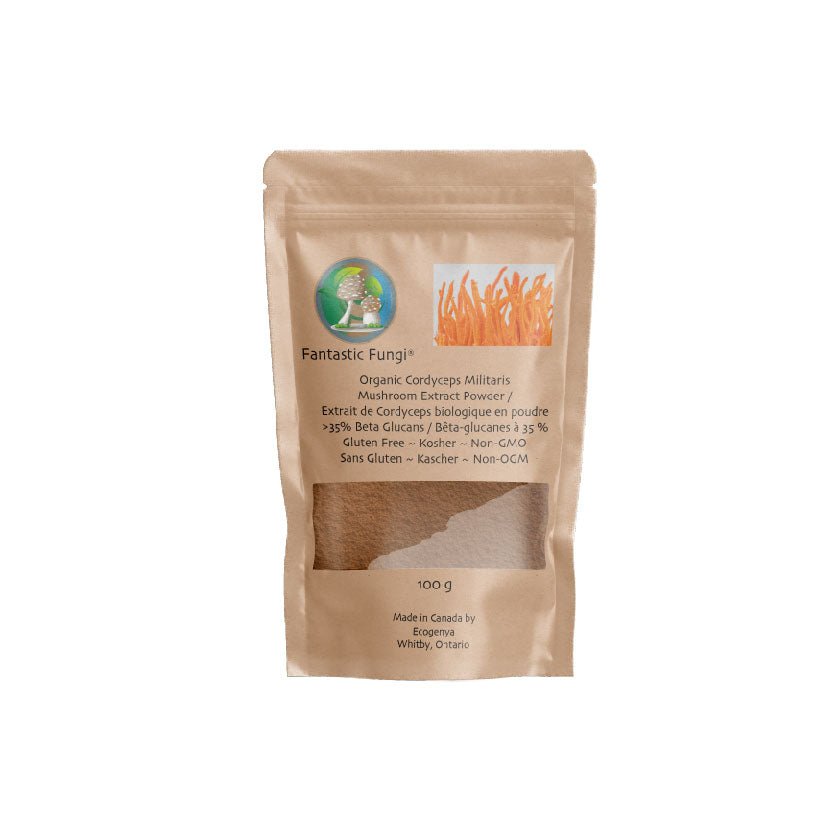
A bright-orange mushroom grown on grain in a lab - not, despite the stories, made from caterpillars. Cordyceps has been prized in Tibetan and Chinese medicine for centuries and adopted by endurance athletes in the last few decades. Here's the honest version: what tradition says, what the (small) human trials actually found, what Health Canada lets us claim, and why the wild species and the cultivated one are two completely different things.
In one minute
Cordyceps militaris is a bright-orange cultivated mushroom grown on grain. It is not made from insects, and it is not the rare wild 'caterpillar fungus.'
That wild relative - Ophiocordyceps sinensis - is a genuinely different species, harvested from moth larvae on the Tibetan plateau, and it can sell for tens of thousands of dollars a kilogram. Nearly everything on shelves today is cultivated militaris.
The best-studied use is endurance: oxygen use, ventilatory threshold and time to exhaustion. The human trials point in a good direction but are small, and several used a mushroom blend or the other species.
It is not a stimulant. There is no caffeine-style hit, and the trials that found effects ran for three weeks or longer.
Health Canada permits antioxidant, fungal-polysaccharide and traditional TCM claims for Cordyceps militaris - it does not permit an energy, stamina or athletic-performance claim.
Well tolerated in the studies to date. The formal Health Canada caution is to check with a practitioner if you are pregnant or breastfeeding.
At a glance
History & natural history
Cordyceps has one of the strangest origin stories in the herbal world, and it's worth telling properly - because the mushroom in your jar has almost nothing to do with the one in the legend.
Winter worm, summer grass
High on the Tibetan plateau, between roughly 3,000 and 5,000 metres, a fungus infects the larvae of ghost moths living underground. It consumes the caterpillar from the inside, mummifies it, and then in late spring pushes a slender brown club up out of the dead insect's head into the alpine air. Herders watching this cycle gave it a name that describes exactly what they saw: Dong Chong Xia Cao - winter worm, summer grass.
That species is Ophiocordyceps sinensis. It was documented in Tibetan medical texts by around the 15th century and entered the Chinese materia medica in the 18th, where it was classified as a warming tonic for the lungs and kidneys - used for chronic cough, exhaustion, convalescence and old age, and reserved largely for those who could afford it.
The most expensive fungus on earth
It still is. Wild caterpillar fungus cannot be farmed commercially - it needs the specific host insect, the specific altitude, the specific climate - so every piece is picked by hand, one at a time, by harvesters crawling across high meadows during a short season. Reported prices run into the tens of thousands of dollars per kilogram, with the best-graded specimens quoted far higher. Whole rural economies in Tibet, Qinghai and Nepal now depend on the annual harvest.
That pressure has consequences. In 2020 the IUCN assessed Ophiocordyceps sinensis as Vulnerable, citing its dependence on a single host, its narrow geographic range and decades of overharvesting. There is also a naming footnote worth knowing: in 2007 the species was moved into the genus Ophiocordyceps, so what older books call Cordyceps sinensis is now formally a different genus from the cordyceps in supplements.
1993, and the athletic reputation
Cordyceps went global for a specific reason. At the 1993 Chinese National Games, distance runners coached by Ma Junren set a series of extraordinary world records, and their coach attributed the results partly to a regimen including cordyceps. The performances drew immediate scepticism, and several of the team's athletes were later caught up in doping cases. But the story stuck, and it is quietly the origin of nearly every 'cordyceps for performance' claim you will read today - long before any of the actual research existed.
The modern mushroom
What changed everything was cultivation. Cordyceps militaris - a separate species, native across the Northern Hemisphere, that also parasitises insect larvae in the wild - turns out to grow perfectly happily on grain or rice in a lab, producing bright orange fruiting bodies in a few weeks. It contains considerably more cordycepin than the wild species does. No insects, no alpine harvest, no wild population under pressure, and a price ordinary people can pay.
So the honest summary: the legend belongs to a rare, expensive, vulnerable wild fungus. The supplement belongs to a cultivated cousin that shares a name, some chemistry, and very little else.
The science, graded honestly
We grade the evidence for every use so you can see the difference between "proven," "promising," and "traditional."
Cordyceps has a reputation as an endurance mushroom, so it helps to understand what researchers actually think is going on - and how much of that is settled.
## The compounds people talk about
Two molecules get most of the attention. Cordycepin (3'-deoxyadenosine) is an unusual nucleoside that looks a lot like adenosine, one of the body's own signalling molecules - which is why it turns up in so much lab research. Adenosine itself is also present. Alongside those sit the fungal polysaccharides, including beta-glucans, which are the compounds behind the immune and antioxidant work across medicinal mushrooms generally. Cultivated Cordyceps militaris is notable because it tends to produce far more cordycepin than the wild species does.
## The energy theory
The most common explanation is that cordyceps supports the way cells make ATP - the molecule your muscles actually spend when they contract. A 2020 Korean study fed mice a Cordyceps militaris extract for 12 weeks and then measured energy-pathway markers in blood. Grip strength rose modestly, and markers tied to ATP production - AMPK in particular - went up, while classic muscle-damage markers mostly did not move. The authors' own conclusion was careful: cordyceps looked like it was nudging energy production rather than reducing fatigue.
That is a mouse study. It tells you the mechanism is plausible. It does not tell you what happens in a person.
## The oxygen theory
The second explanation, and the one that lines up best with the human trials, is about oxygen. Older pharmacology work suggested cordyceps compounds relax blood vessels and improve blood flow, which would mean more oxygen reaching working muscle at any given effort. That fits what the human studies actually measured: the consistent findings are in ventilatory and metabolic threshold - the point where breathing has to ramp up sharply - rather than in raw power or sprint output.
## What this means practically
If cordyceps does anything for you, the mechanism suggests it will show up as being able to hold a hard effort slightly longer, or feeling that a given pace costs a bit less - not as a jolt of energy. It also explains why every trial that found something ran for weeks, not hours.
Exercise performance
Emerging but limitedThis is the reason most people buy cordyceps, so it deserves a careful look at what the studies actually did.
The headline militaris trial is Hirsch and colleagues at the University of North Carolina, published in the Journal of Dietary Supplements in 2016. Twenty-eight recreationally active adults, average age 23, were randomly assigned to take either 4 g a day of a mushroom blend or an identical maltodextrin placebo, with neither the participants nor the researchers knowing who got which. They were tested on a cycle ergometer - a graded ride to exhaustion measuring maximal oxygen uptake (VO2max), how long they lasted, and their ventilatory threshold, plus a separate three-minute all-out power test. After one week, nothing. No significant difference between the mushroom group and placebo on any measure. Ten of the participants then volunteered to continue for another two weeks. In that much smaller group - six on the supplement, four on placebo - VO2max rose significantly in the supplement group (up 4.8 ml/kg/min, about 11%) while placebo barely moved, and time to exhaustion and ventilatory threshold improved too.
That is a genuinely encouraging result, and it needs three honest caveats. First, the three-week phase had ten people in it. Ten. Second, the supplement was not pure Cordyceps militaris - it was a commercial six-mushroom blend (PeakO2) that also contained reishi, king trumpet, shiitake, lion's mane and turkey tail, so the result cannot be cleanly attributed to cordyceps. Third, the study was funded by a supplement company, which the authors disclosed.
The rest of the literature is genuinely mixed. Several trials in trained cyclists - Parcell 2004, Earnest 2004, Colson 2005 - used lower doses of Cordyceps sinensis-derived products and found no benefit to endurance performance at all. A 2026 narrative review in Nutrients gathered every Cordyceps militaris human intervention study it could find: five trials, 321 participants in total, doses from 1 to 12 g a day for one to sixteen weeks, many of them multi-ingredient formulas. It reported improvements in VO2max, time to exhaustion and markers of muscle damage across those studies while noting how varied and small they were.
The fair summary: the direction of the evidence is positive, the doses that seem to matter are 3-4 g a day or more, and consistency over weeks matters more than anything you do on the day. But nobody has yet run a large trial on pure Cordyceps militaris, and Health Canada does not permit a performance claim on this basis. Neither do we.
Hirsch et al. 2016, Journal of Dietary Supplements ↗Oxygen use & aerobic threshold
Emerging but limitedThis is the most consistent finding in the cordyceps literature, and interestingly it comes from older adults rather than athletes.
Chen and colleagues at UCLA published a double-blind, placebo-controlled trial in the Journal of Alternative and Complementary Medicine in 2010. Twenty healthy adults aged 50 to 75 took either 333 mg of Cs-4 or a matching placebo three times a day - 1 g daily - for 12 weeks. Each did a graded exercise test at the start and end, with researchers measuring metabolic threshold and ventilatory threshold: essentially, how far into an increasing workload you can go before your body switches gears. After 12 weeks the Cs-4 group's metabolic threshold had risen 10.5% and ventilatory threshold 8.5%, both statistically significant. The placebo group showed no meaningful change. Notably, VO2max did not change in either group - so this was an efficiency effect, not a raw capacity effect.
An earlier Chinese trial by Yi and colleagues, published in the Chinese Journal of Integrative Medicine in 2004, ran a similar design in healthy elderly volunteers at a higher dose - 3 g a day of Cs-4 for six weeks - and reported a 6.7% improvement in VO2max and a 12.6% improvement in anaerobic threshold.
The honest limitations are the same ones that follow cordyceps everywhere. Twenty people is a small trial. Both studies used Cs-4, a fermented mycelium product derived from the sinensis lineage - not the Cordyceps militaris in most products today. And in Chen's study the dose was 1 g a day, well below what the militaris exercise trials used, which makes the dose-response picture confusing rather than clear.
What is worth taking from this: where cordyceps shows an effect, it shows up in threshold and efficiency measures rather than power or peak capacity, and it shows up after months rather than days. That is a coherent, modest, believable story - just not a finished one.
Chen et al. 2010, Journal of Alternative and Complementary Medicine ↗Energy & fatigue
Traditional use'Energy' is the word cordyceps gets sold on, and it is the word with the least direct human evidence behind it. Worth separating what we actually know.
The traditional record is real and long. In Traditional Chinese Medicine, Dong Chong Xia Cao is used to tonify and replenish the lungs and kidneys and to resolve phlegm, and it has a documented history as a restorative for people recovering from illness or exhaustion. Health Canada recognises exactly this traditional use for Cordyceps militaris in its Mushrooms monograph - and recognises nothing about energy, stamina or fatigue as a modern claim. That gap is meaningful.
The mechanistic support is mostly in animals. In a 2020 study in Mycobiology, mice were given a Cordyceps militaris ethanol extract at three doses for 12 weeks. Grip strength ended up around 10 grams-force higher than untreated controls, comparable to a red ginseng comparison group. When the researchers looked at blood markers, the fatigue-related ones (LDH, AST, ALT, creatine) barely moved, but energy-production markers did - AMPK rose significantly at every dose, with ATP, GLUT4 and phosphocreatine trending upward. The authors concluded, carefully, that cordyceps appeared to be supporting ATP generation rather than reducing muscle fatigue. Mice, though - not people.
What there isn't: a good randomised trial in humans measuring subjective energy, tiredness or fatigue scores after taking Cordyceps militaris. Some of the exercise trials measured muscle-damage markers like blood urea nitrogen and creatine kinase and found reductions, which is suggestive of better recovery, but that is a different thing from feeling less tired.
So we grade this traditional use. The history is genuine, the mechanism is plausible, and if you take it and feel more durable, that is worth something - but we are not going to tell you the science has shown it, because it hasn't yet.
Health Canada NNHPD Mushrooms monograph (TCM claim for Cordyceps militaris) ↗Immune support
Emerging but limitedThis is the one area where Health Canada actually lets us say something. Its Mushrooms monograph permits Cordyceps militaris to be described as a source of fungal polysaccharides with immunomodulating properties - a compositional statement about what is in the mushroom and how those compounds behave, not a promise that you will get sick less often. Worth holding that distinction firmly.
The human data is thin but real. A randomised controlled trial published in Scientific Reports in 2024 by researchers in Phayao Province, Thailand, tested a beverage made by submerged fermentation of Cordyceps militaris, standardised to 2.85 mg of cordycepin per serving. Healthy adult volunteers - ten men and ten women per arm - drank either the fermented cordyceps beverage or a placebo daily for eight weeks, with blood drawn at baseline, four weeks and eight weeks to measure immune cell markers, immunoglobulins and safety bloodwork. The clearest signal was natural killer cell activity, which rose significantly in the male supplement group by week four. Results in the female group and across the other markers were less clear-cut, and no safety problems showed up.
Be honest about what that is: twenty people per sex, eight weeks, one product, a finding in a laboratory marker rather than in whether anyone actually got ill. NK cell activity going up in a blood sample is interesting biology; it is not the same as a demonstrated benefit.
The wider background is more supportive than the specifics. Fungal polysaccharides from a range of mushrooms have been shown in cell and animal studies to activate immune signalling, and Health Canada reviewed that body of literature when it wrote the monograph. What is missing is a large trial in people, taking cultivated Cordyceps militaris, with a real-world outcome. Until that exists, this stays graded emerging.
Oh et al. 2024, Scientific Reports 14:7994 ↗Antioxidant support
Well establishedThis is the best-supported thing we can say about cordyceps, and it is also the least exciting - which is a useful reminder about how supplement claims work.
Health Canada permits Cordyceps militaris to be labelled a source of antioxidants, and permits the associated wording about providing antioxidants that help protect cells against free radicals. The monograph backs that with a long reference list of compositional and laboratory analyses - dozens of published studies characterising cordyceps polysaccharides, phenolics and related compounds and measuring their free-radical-scavenging activity in standard assays.
Here is the important nuance. 'Source of antioxidants' is a compositional claim. It says these compounds are present in the material and that they behave as antioxidants under test conditions. It is well established in exactly that sense - the chemistry is not in doubt. What it does not say, and what nobody should read into it, is that taking cordyceps produces a measurable antioxidant benefit in your body, reduces oxidative stress in a way you would feel, or prevents anything. Those would be different claims requiring different evidence, and Health Canada has not granted them.
In practice, this is why 'source of antioxidants' appears on so many labels: it is a statement about what is in the jar, verifiable by lab analysis, rather than a statement about what happens to you. We would rather explain that than let it do work it hasn't earned.
One genuinely relevant angle for athletes: hard exercise generates oxidative stress, and part of the theorised endurance mechanism for cordyceps involves buffering that. That is a plausible link between this graded claim and the exercise research - but it remains a theory connecting two things, not a demonstrated result.
Health Canada NNHPD Mushrooms monograph (antioxidant claim, Cordyceps militaris) ↗Libido & hormones
PreliminaryThis claim shows up constantly in cordyceps marketing, so it is worth being blunt about where it comes from.
The reputation is old and genuine. Wild caterpillar fungus has been valued as an aphrodisiac and vitality tonic in Chinese, Tibetan and Nepalese traditional medicine for a very long time, and part of the extraordinary price it commands in Asia is tied to that reputation.
The modern evidence is entirely preclinical. Studies in rats and mice have reported increases in circulating testosterone after cordyceps administration, with a proposed mechanism running through cAMP and protein kinase A signalling in the testicular cells that manufacture testosterone. Some of this work used Ophiocordyceps sinensis, some used Cordyceps militaris. All of it is in animals or isolated cells.
What does not exist, as far as we can find: a randomised, placebo-controlled trial in humans measuring testosterone, libido or sexual function after taking Cordyceps militaris. Not a small one, not a poor one. There is a real difference between 'we haven't found strong evidence' and 'we haven't found the trial at all,' and this is the second situation.
That matters practically. Animal hormone results translate to humans poorly and unpredictably - doses in rodent studies are often far higher relative to body weight than anything you would take, and hormonal systems differ between species. Health Canada permits no claim of this kind for cordyceps, and neither do we.
If you are buying cordyceps for this reason, we would rather you knew that you are buying on the strength of tradition and rodent data. That may still be a reasonable personal choice. It just isn't a scientific one yet.
Memorial Sloan Kettering, About Herbs: Cordyceps ↗Who it's for - and who it isn't
It makes most sense if
You train endurance - running, cycling, rowing, hiking, climbing, martial arts - and you are looking for a small, gradual edge in how long you can hold a hard effort.
You are willing to take it daily for at least three to four weeks before judging it. Every human trial that found something ran that long or longer.
You want something in your routine that is not a stimulant, because you already have enough caffeine in your day.
You are middle-aged or older and want gentle support for aerobic capacity. The clearest single result in the literature came from adults aged 50 to 75.
You like the traditional framing: in Traditional Chinese Medicine, Dong Chong Xia Cao is used to tonify and replenish the lungs and kidneys and resolve phlegm. That is the claim Health Canada actually permits.
It probably isn't for you if
You want to feel something today. Cordyceps is not a pre-workout in the way caffeine is a pre-workout, and treating it like one leads to disappointment.
You are chasing testosterone, libido or muscle growth. That evidence is in rodents, not people.
You are a highly trained competitive athlete looking for a decisive advantage. Several trials in trained cyclists found nothing at all.
You are pregnant or breastfeeding. Health Canada's monograph asks you to consult a practitioner first, and there simply isn't safety data to work from.
You are on medication - particularly anything affecting blood sugar or immune function. Talk to your prescriber first.
Militaris vs. the wild caterpillar fungus
This is the single biggest source of confusion in the cordyceps aisle, and it is worth getting right, because the two things being compared are not the same organism.
The wild one: Ophiocordyceps sinensis
High on the Tibetan plateau, a fungus infects the larvae of ghost moths. It kills the caterpillar underground, mummifies it, and in spring pushes a thin brown club out of the dead insect's head. Harvesters walk the alpine meadows at 3,000 to 5,000 metres picking them one at a time. In Chinese it is Dong Chong Xia Cao - 'winter worm, summer grass.'
It is spectacularly expensive. Reported prices run into the tens of thousands of dollars per kilogram, with top grades quoted far higher, which makes it one of the most valuable biological commodities on earth. It also cannot be farmed at commercial scale, which is exactly why it costs what it costs. The IUCN assessed it as Vulnerable in 2020, citing its dependence on a single host insect, its narrow range, and decades of overharvesting.
One more wrinkle: it was reclassified in 2007. What older books call Cordyceps sinensis is now formally Ophiocordyceps sinensis - a different genus. So when a label says 'Cordyceps sinensis,' it is usually either an old name, a fermented mycelium product like Cs-4, or marketing.
The cultivated one: Cordyceps militaris
Cordyceps militaris is a separate species that will happily fruit on grain or rice in a lab. No insects involved - the products you buy are grown on a vegan substrate. It produces bright orange, finger-shaped fruiting bodies, and it makes considerably more cordycepin than the wild species does.
What that means for you
Almost every affordable cordyceps product is cultivated militaris. If a product is cheap and says 'sinensis,' be sceptical.
Cs-4 is a third thing again: a fermented mycelium product derived from the sinensis lineage, developed in China and used in several of the older clinical trials. It is neither wild sinensis nor militaris.
This matters when reading studies. The two most-cited exercise results used Cs-4, not militaris. The best militaris trial used a six-mushroom blend. Nobody has yet run a large trial on pure Cordyceps militaris alone.
Ethically and ecologically, cultivated militaris is the easy call: no wild harvest, no pressure on a vulnerable species, no insect.
How it compares to caffeine, beetroot and creatine
It helps to place cordyceps honestly among the things people actually take before training.
Caffeine
Caffeine is the most reliably effective legal performance aid there is, and it works within an hour. Cordyceps is the opposite on both counts: nothing acute, and the effect - if you get one - takes weeks to appear. They also work through completely different routes. Caffeine changes how hard the effort feels by acting on the brain; cordyceps is theorised to work on oxygen delivery and cellular energy. If you want a jolt, caffeine is the honest answer. Cordyceps is a background ingredient, not a stimulant, which is exactly why some people like it in the evening or on top of an already caffeinated day.
Beetroot / dietary nitrate
Beetroot has the closer overlap - it also targets oxygen economy - but it has far more human evidence behind it, with dozens of trials and consistent effects on the oxygen cost of submaximal exercise. If your only goal is endurance economy and you want the best-supported option, beetroot is ahead of cordyceps on evidence volume.
Creatine
Different job entirely. Creatine is for short, powerful efforts and strength work, and it is one of the most thoroughly studied supplements in existence. Cordyceps showed no convincing effect on average power output in the trial that measured it. These two are not competitors.
Where cordyceps genuinely sits
A plausible, gently supported, non-stimulant endurance ingredient with a long traditional history and a good safety record - with less human evidence than caffeine, beetroot or creatine, and study results that are encouraging rather than conclusive. That is a reasonable thing to take. It is not a reasonable thing to expect miracles from.
Practitioner note
A few things worth knowing if you work with clients, or if you like reading labels properly.
The regulatory position in Canada
Health Canada's Mushrooms monograph lists Cordyceps militaris with three permitted claim routes: source of antioxidants, source of fungal polysaccharides with immunomodulating properties, and the traditional TCM claim - used in Traditional Chinese Medicine to help tonify and replenish the lungs and kidneys, and resolve phlegm. There is no permitted energy, stamina, endurance or athletic-performance claim. That is not an oversight; it reflects the state of the evidence. Anything you read about VO2 max on this page is research context, not an approved claim, and it does not belong on a Canadian product label.
The doses the monograph allows
Dried or powdered material: up to 3 g per day. Aqueous extracts: up to 9 g per day of dried-material equivalent. For the TCM claim specifically: 1.5 to 3 g per day of dried cultured fruiting body, cultured mycelium or stroma; 3 to 9 g per day as a decoction. Note that the exercise trials generally used 3 to 4.5 g per day - at or slightly above the top of the Canadian powdered range.
Reading the literature carefully
Three different things get lumped together as 'cordyceps': wild Ophiocordyceps sinensis, the fermented Cs-4 mycelium product, and cultivated Cordyceps militaris. Chen 2010 and Yi 2004 - the two most-quoted exercise trials - both used Cs-4. Hirsch 2016, the militaris trial, used a six-mushroom commercial blend, so you cannot cleanly attribute its result to cordyceps alone. When a brand cites 'the research,' it is usually citing one of these three, and often not the one in the tub.
Practical cautions
Memorial Sloan Kettering's About Herbs entry notes no major side effects reported, but flags caution for anyone on insulin or other glucose-lowering medication. Health Canada's risk statement for Cordyceps militaris is to consult a practitioner before use if pregnant or breastfeeding. Because fungal polysaccharides are immunomodulating, use judgement with clients on immunosuppressants or with autoimmune conditions - this is a precaution based on mechanism rather than a documented interaction.
— Memorial Sloan Kettering, About Herbs: Cordyceps
What we're actually allowed to say
Myth or fact?
Tap each one to see the verdict.
True of the wild species, not of what you are buying. Ophiocordyceps sinensis genuinely does grow out of the mummified larvae of ghost moths on the Tibetan plateau - that is where 'caterpillar fungus' comes from, and it is why the IUCN listed the species as Vulnerable in 2020 after decades of overharvesting. But Cordyceps militaris, the species in virtually every affordable supplement, is a different organism that is cultivated on grain or rice in a lab. No insects are involved at any stage, which is why cultivated cordyceps products are vegan. If you want to be certain, check the Latin name on the label: militaris means cultivated and insect-free. IUCN Red List: Ophiocordyceps sinensis (2020 assessment) ↗
Cordyceps contains no stimulant, and the research does not support an acute effect. The clearest test of this was Hirsch's 2016 trial: 28 active adults took 4 g a day for a full week and showed no significant improvement over placebo on oxygen uptake, time to exhaustion, ventilatory threshold or power output. Only after three weeks of continued daily use did differences appear. Every other trial that found something ran for six to twelve weeks. If you feel a rush twenty minutes after taking cordyceps, that is either the coffee you mixed it into or expectation - neither of which is a criticism, but neither of which is the mushroom. Treat it as a daily background ingredient, like fibre or omega-3s, not a pre-workout. Hirsch et al. 2016, Journal of Dietary Supplements ↗
In rodents, there is data. In humans, there is none. Studies in rats and mice have reported increased testosterone after cordyceps administration, with a proposed mechanism in the cells that produce it - and the wild species has a centuries-old reputation as an aphrodisiac. But no randomised, placebo-controlled human trial has measured testosterone, libido or sexual function after Cordyceps militaris supplementation. Animal hormone findings translate to humans badly, often using doses far higher relative to body weight than anyone takes. Health Canada permits no claim of this kind, and any product marketed to you on this basis is selling you rodent data. Memorial Sloan Kettering, About Herbs: Cordyceps ↗
On the compound that gets talked about most, the cultivated species wins. Cordyceps militaris typically produces substantially more cordycepin than wild Ophiocordyceps sinensis does - the reason it became the commercial species in the first place. Wild sinensis commands its price because it is rare, hard to harvest and culturally prized, not because analysis shows it to be stronger. The comparison is also awkward because they are different species with different chemistry, so 'better' depends entirely on what you are measuring. Add the conservation picture - a Vulnerable species, harvested by hand from alpine meadows, under pressure for decades - and cultivated militaris is the more sensible choice on potency, price and ethics at once. Wild is not a quality signal here. It is a scarcity signal. IUCN Red List: Ophiocordyceps sinensis (2020 assessment) ↗
This story is the origin of cordyceps' athletic reputation, and it proves nothing. At the 1993 Chinese National Games, athletes coached by Ma Junren set extraordinary distance-running records, and their coach credited a training and nutrition programme that included cordyceps and turtle blood. The performances were met with widespread scepticism at the time, and several of the team's athletes were later caught up in doping cases. Even setting that aside, a coach's anecdote about a handful of elite athletes taking multiple substances at once is not evidence of anything. It is worth knowing this history precisely because it is quietly behind so much cordyceps marketing - the actual scientific case for cordyceps rests on a handful of small modern trials, not on a 1993 press conference. Hirsch et al. 2016, Journal of Dietary Supplements (background section) ↗
How to use it
Common forms
How much
Health Canada permits up to 3 g/day of dried or powdered Cordyceps militaris, or up to 9 g/day of dried equivalent as an aqueous extract. For the traditional TCM claim specifically, the range is 1.5-3 g/day. Most people take 1-3 g of powder daily; concentrated extracts are dosed much lower, so follow the label rather than scaling from powder numbers. For context, the human exercise trials mostly used 3-4.5 g/day - trials at 1-2 g/day generally found nothing. Timing is flexible because there is no stimulant: morning or evening both work, with or without food. What matters far more than dose or timing is taking it daily for at least 3-4 weeks, since no trial found an effect sooner than that.
1/2 to 1 tsp in coffee, tea or a smoothie.
Four things worth checking before you buy:
The species, in Latin. You want Cordyceps militaris. A cheap product claiming 'Cordyceps sinensis' is either using an outdated name, selling Cs-4 mycelium, or being loose with the truth - real wild sinensis costs tens of thousands of dollars a kilo.
Fruiting body, not grain-grown mycelium. Mycelium products are grown on grain and sold with the substrate still in them, which dilutes the actives. The orange fruiting body is where the cordycepin is.
Beta-glucans, not just 'polysaccharides.' A bare polysaccharide number can be padded with starch from the growing substrate. Beta-glucan is the meaningful measure.
Third-party testing. Look for verified heavy metal testing and a stated active content - cordycepin or beta-glucan - rather than vague 'high potency' language.
Frequently asked questions
Straight answers to the things people actually ask.
Cordyceps is a genus of fungi with a long history in Traditional Chinese and Tibetan medicine. The version in modern supplements is almost always Cordyceps militaris - a cultivated species that grows bright orange, finger-shaped fruiting bodies on grain or rice in controlled conditions. Its signature compounds are cordycepin and adenosine, plus fungal polysaccharides including beta-glucans. In TCM it is known as Dong Chong Xia Cao and used to tonify and replenish the lungs and kidneys and resolve phlegm; in the modern world it is best known as an endurance ingredient, though that use is still being researched rather than settled.
They are different species, and the distinction matters more than almost anything else on a cordyceps label. Ophiocordyceps sinensis - reclassified out of the Cordyceps genus in 2007 - is the wild 'caterpillar fungus' that grows from moth larvae on the Tibetan plateau. It cannot be farmed at scale, sells for tens of thousands of dollars a kilogram, and was assessed by the IUCN as a Vulnerable species in 2020. Cordyceps militaris is a separate species that is easily cultivated on grain, contains considerably more cordycepin, involves no insects, and costs a tiny fraction as much. There is also a third thing sold under the cordyceps name: Cs-4, a fermented mycelium product from the sinensis lineage used in several older clinical trials. If a product is affordable and doesn't say militaris, it is worth asking what is actually inside.
The honest answer has three layers. What Health Canada permits us to say: it is a source of antioxidants and of fungal polysaccharides with immunomodulating properties, and it is used in Traditional Chinese Medicine to help tonify and replenish the lungs and kidneys and resolve phlegm. What the research is exploring: endurance. Small human trials have found improvements in oxygen uptake, breathing threshold and how long people could sustain hard exercise - though other trials found nothing, the studies are small, and several used a different species or a mushroom blend. What it does not do: act as a stimulant, raise testosterone in humans, or produce anything you would notice on the first day. If you take it, expect a subtle, gradual effect on endurance at best, and be pleased rather than disappointed.
Health Canada's monograph sets the ceiling for Cordyceps militaris at 3 g a day of dried or powdered material, or up to 9 g a day of dried equivalent as an aqueous extract. For the traditional TCM claim specifically, the range is 1.5 to 3 g a day. Most people land at 1 to 3 g of powder daily, or whatever a concentrated extract's label specifies - extracts are dosed much lower because they are more concentrated, so always follow the label rather than scaling from powder figures. For reference, the human exercise trials generally used 3 to 4.5 g a day, at or slightly above the top of the Canadian powdered range, and the trials using 1 to 2 g a day mostly found nothing. Consistency matters more than precision: a smaller dose taken every day beats a larger dose taken sporadically.
You can, but not because the timing does much. Cordyceps is not a stimulant and the evidence does not support an acute, same-session effect: in the best militaris trial, a full week of 4 g a day produced no measurable performance difference versus placebo, and only three weeks of daily use showed anything. So taking it thirty minutes before a session is unlikely to change that session. Take it at whatever time you will actually remember every day - morning coffee is the most common answer because it is a habit people already have. There is no stimulant, so an evening dose won't affect sleep. Think of it as building a background over weeks rather than priming a workout.
Longer than most people expect. In the Hirsch trial, one week of supplementation produced nothing; the improvements appeared after three weeks. The two older Cs-4 trials ran for six and twelve weeks respectively. So the realistic answer is three to four weeks minimum before you can fairly judge it, and eight to twelve weeks for a proper trial of it. Be honest with yourself about what you're looking for, too: the measurable effects in the studies were things like breathing threshold and time to exhaustion, which you would notice as being able to hold a hard pace slightly longer - not as a feeling. If two months of consistent daily use has changed nothing, it isn't working for you, and stopping is a reasonable decision.
It has a good record. Memorial Sloan Kettering's About Herbs database notes no major side effects reported for cordyceps. In the human trials we looked at, including an eight-week immune study that ran full safety bloodwork, no significant safety problems emerged. Health Canada permits Cordyceps militaris in licensed natural health products up to 3 g a day of powdered material, with a single required risk statement: consult a health care practitioner before use if you are pregnant or breastfeeding. The most common practical issue is simply mild digestive upset when starting, which usually settles - starting at a lower dose for the first week helps. As with any mushroom product, avoid it if you have a known mushroom allergy, and stop if any hypersensitivity reaction occurs.
Anyone pregnant or breastfeeding should check with a practitioner first - this is Health Canada's formal risk statement for Cordyceps militaris, and it reflects a lack of safety data rather than a known problem. Skip it if you have a mushroom allergy. Be cautious and speak to your prescriber first if you take insulin or another blood-sugar-lowering medication, which is the specific interaction Memorial Sloan Kettering flags. Use judgement if you have an autoimmune condition or take immunosuppressant medication: cordyceps is recognised as a source of fungal polysaccharides with immunomodulating properties, and while there is no documented interaction, it is sensible to check rather than assume. Children have not been studied - the Health Canada monograph covers adults 18 and over only.
There are no well-documented, clinically confirmed drug interactions for cordyceps, but there are two sensible cautions. The first is blood sugar: Memorial Sloan Kettering advises talking to your provider if you take insulin or other glucose-lowering medication, since some cordyceps research points to effects on glucose handling and you would want to be monitoring rather than surprised. The second is immune-modulating medication - because cordyceps supplies fungal polysaccharides with immunomodulating properties, it is worth a conversation with your prescriber if you take immunosuppressants or are managing an autoimmune condition. Neither of these is a proven interaction; both are reasonable precautions based on how the ingredient behaves. And the general rule holds: supplements are more concentrated than culinary mushrooms, so tell whoever manages your prescriptions what you are taking.
Side effects & safety
- Pregnancy & breastfeeding: Health Canada's required risk statement: consult a health care practitioner before use. This reflects a lack of safety data rather than a known problem.
- Mushroom allergy: It's a mushroom. Avoid it if you react to mushrooms, and stop use if any hypersensitivity reaction occurs.
- Blood sugar & diabetes medication: Memorial Sloan Kettering advises speaking to your provider if you take insulin or another glucose-lowering drug. A precaution, not a confirmed interaction.
- Autoimmune conditions & immunosuppressants: Cordyceps supplies fungal polysaccharides with immunomodulating properties, so check with your prescriber first. Based on mechanism, not a documented case.
- Getting started: The most common complaint is mild digestive upset in the first week. Starting at a lower dose and building up usually settles it.
- Adults only: The Health Canada monograph covers adults 18 and over. Cordyceps has not been studied in children.
The bottom line
Cordyceps is one of the more interesting mushrooms and one of the most oversold.
What is solid: it is a real traditional medicine with centuries of documented use, Health Canada recognises it as a source of antioxidants and fungal polysaccharides, cultivated Cordyceps militaris is cheap and sustainable to produce, and it has a reassuring safety record in the trials run so far.
What is promising but genuinely unfinished: the endurance story. Several small, well-designed human trials found improvements in oxygen use, breathing threshold and time to exhaustion - and several other trials, mostly in already-trained cyclists at lower doses, found nothing. A 2026 narrative review pulling together five Cordyceps militaris trials counted 321 participants in total across all of them. That is not a large evidence base, and the studies used different species, doses and preparations.
What is not supported: anything about testosterone, libido or muscle growth in humans, and any suggestion that it works like a stimulant.
So: a fair thing to try if you train and you are patient. Take it daily for at least three to four weeks, expect a small effect on how long you can hold a hard effort rather than a noticeable buzz, and judge it honestly. If nothing changes after two months, it is not working for you, and that is a perfectly normal outcome with an ingredient at this stage of the evidence.
References
Every graded claim links to its source; here they are together.
- Exercise performance: Hirsch et al. 2016, Journal of Dietary Supplements
- Oxygen use & aerobic threshold: Chen et al. 2010, Journal of Alternative and Complementary Medicine
- Energy & fatigue: Health Canada NNHPD Mushrooms monograph (TCM claim for Cordyceps militaris)
- Immune support: Oh et al. 2024, Scientific Reports 14:7994
- Antioxidant support: Health Canada NNHPD Mushrooms monograph (antioxidant claim, Cordyceps militaris)
- Libido & hormones: Memorial Sloan Kettering, About Herbs: Cordyceps
- IUCN Red List: Ophiocordyceps sinensis (2020 assessment)
- Hirsch et al. 2016, Journal of Dietary Supplements
- Memorial Sloan Kettering, About Herbs: Cordyceps
- IUCN Red List: Ophiocordyceps sinensis (2020 assessment)
- Hirsch et al. 2016, Journal of Dietary Supplements (background section)